



Product Development has never been so strategic. Looking for the best usability, the usual design process now gives massive importance to the user: what they expect to do with the service (the problem they wish to solve), and how they are supposed to achieve it (what actions you want them to perform).
In the last years, web production & design dramatically evolved from searching for stylized interfaces to searching for usable interfaces. Developing a product combines utility and usability, in the end-user interest. As a result, acclaimed apps in the world of UI & UX designers often combine the most efficient & straightforward design to the most direct & simple user outcome.
- Table of Content
- Bloody Humans.
- The Shadow Zone In Your Product
- Shadow Zone. Not No-Go Zone.
- Don’t Be Afraid Of The Darkness.
Bloody Humans.

citation by French Philosopher Jean-Paul Sartre
Your User is a person.
Most probably, a free person, responsible for its acts, with free will. And with skills, forces, but also weaknesses and defaults. Each one, unique and very different from the other.
Which makes very unlikely the fact that your user will act like you expect him to.
Quite not true, though.
Because with the years, good practices in design and experience appeared and still evolve in time. They streamlined the way we consume the services online. Web & mobile users adopted codes and developed habits.
UI designers are able to create or reproduce visual environments that look familiar.
This will bring you to reach decent levels quickly. Let’s say most users act the same way and perform what you expect them to do. Nevertheless, this count also gives us a minor part of the users who don’t act as expected regularly.
This is why you may miss the point when introspecting your product.
The Shadow Zone In Your Product
You can build the best features to solve a problem that beat all the competition in terms of effectiveness, ease, and time of use.
With the most streamlined experience, you can optimize the usage of your features as you do with conversion funnels, adopt a rich analytics strategy with the right usage KPIs to ensure that your product delights most of its users.
You still miss considering a crucial part of the user base: the amount of unexpected usage.
This inevitable, unshakable, uncontrollable part of the people that will never act like you expect them to:
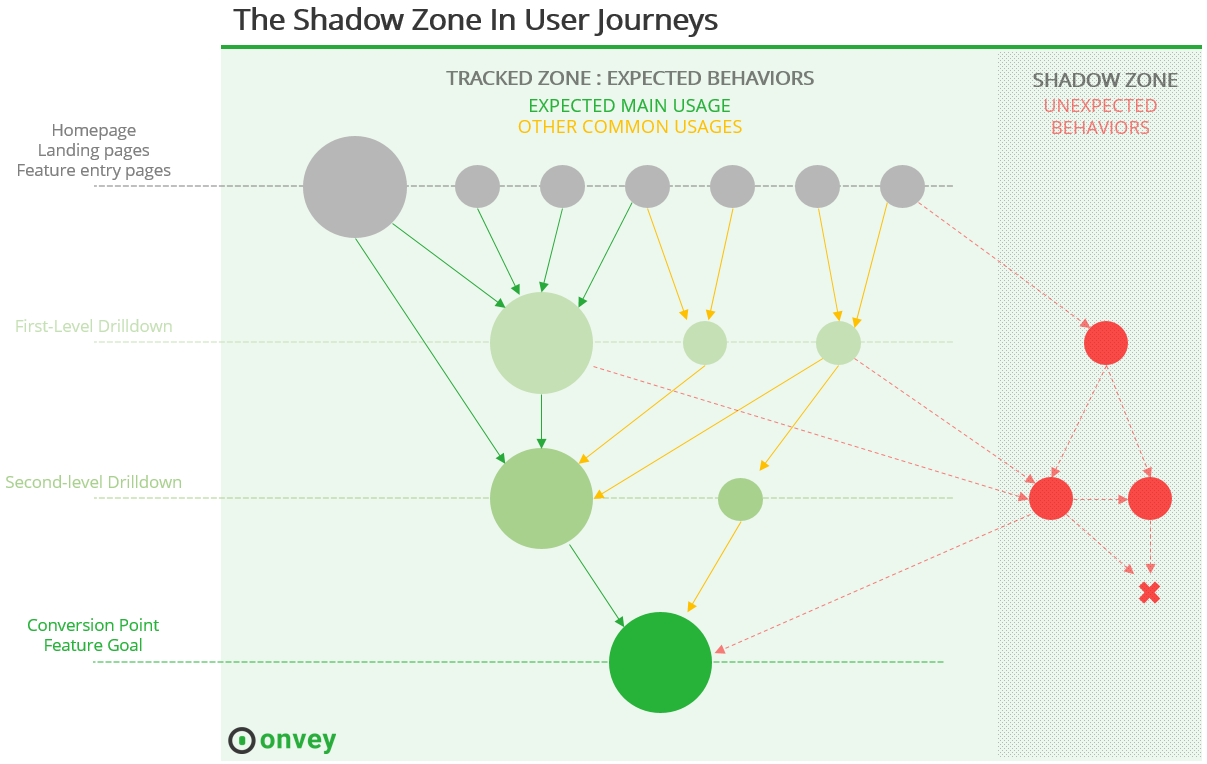
That you want it or not, some users will enter this shadow zone.
What defines the shadow zone:
- It’s outside of any of your conversion, activity, and feature funnels
- Users who are in this zone may -or not really- be experiencing difficulties with the product. But in this case, it can generate frustration and damage their user experience.
- Product owners have few ways to detect these unexpected behaviors and sometimes neglect to address them.
Generally speaking, it’s the part outside your radar.
Measuring users’ behavior is measuring all the different behaviors, not only the ones you expect.
Shadow Zone. Not No-Go Zone.
This shadow zone of unexpected behaviors is hard to conceive, which makes it challenging to investigate. There is a challenge in the fact of tracking unexpected / out-of-scope behaviors. What to expect? How to differentiate isolated weird behaviors from common problems that several users meet?
But that it’s hard to reach doesn’t mean it doesn’t exist, neither that you should ignore it.
Web product owners, be happy. It could even be worse. At least you don’t have to track behaviors offline like mobile apps sometimes must. Here is a double example of a "deep" shadow zone that features an annoying or poor experience for the user:
Ever tried to launch the Spotify app while disconnected from the data network?
Well, here is what happens:
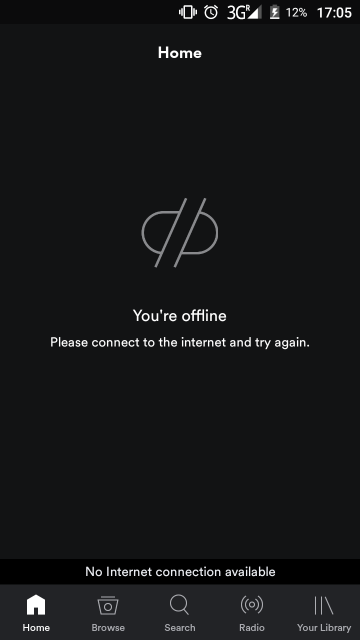
Not what I call a warm welcome.
Fine. I am offline. And also there is no internet connection available. Oh, wait. It’s the same. Anyway, thank you for letting me know. Now, let’s press the small library button so that I can get to my music, then playlists, then – oh excellent, music.
Quite dull, this intermediary step. What is his purpose? Spotify has good reasons to want people connected. Usage tracking, personalization of the recommendations and playlists, artists promotion, ...
This specific behavior sucks, and it’s out of their scope, in the shadow zone, for two simple reasons:
- At this moment, the user isn’t looking for music, nor listening for music, nor socializing around music .. he’s outside any funnel they drew, just trying to get to the next interface where he could finally access his music. This is the part that could easily be fixed with proper analytics on the shadow zone.
- But here, the user is disconnected, which means that Spotify may eventually not track any activity for the user at this moment - analytics providers don’t all make this possible.
What Spotify misses here :
- I want music.
- I have music synchronized on my phone.
- The data network is off because I travel abroad.
- I tapped on "library" immediately every time after I had this screen (the part you can understand and fix with proper usage tracking)
- It’s a marginal case, but among 40 million users, I am probably not alone (the common problematic and questioning behaviors are those you must focus on).
- It’s an annoying one - and no one wants to annoy its customers.
- They could draw direct routes to my music anyway - this bloody screen is empty!
This example gets in count in damaging my experience while using the app, making it a pain to launch it, and brings me to look into alternatives. Offline or not doesn’t make me more indulgent.
Don’t Be Afraid Of The Darkness.
When building your product, once you defined the goals for each feature - potentially based on your user stories, you will want to check you did your job correctly by analyzing proper usage KPIs. But this is only the first step.
Once everything runs well, and once you have satisfying levels of usage for the most significant part of the user base, it’s interesting to look into this part of darkness which is the shadow zone.
For this, you must work on detecting the existing and actual unexpected usages made of your product and that you did not plan.
Paying attention to these behaviors through specific usage KPIs allows you to understand actual usability & user dispersion problems that you could not anticipate. And bring lost sheep to the right path, delivering a better experience and building better satisfaction.
It’s not about fixing any individual problem. Some people may be unable to use your product correctly because, for instance, they miss some requested skills. The goal of this operation is to detect, among the different use cases that appear, which ones are sufficiently common and impact your conversion, retention, or the user experience to fix them.
Don’t draw a rule from every single example, but find the meaningful examples that are actually common behaviors that you did not expect.
The better your designer is, the most direct and non-dispersive the experience and journey in your product will be, and the smaller the shadow zone will be too.
Once you optimize your conversion and usage funnels (of expected behaviors), jump into usage tracking about the shadow zone. As reduced as this part can be, you can find a benefit in fixing problems that just a few users will face but turn out to be huge ones. Find where are the unexpected and out-of-scope common behaviors, and address them one by one.
Work on the unexpected behaviors to bring them back in your strategy.
Also, you must accept that there is an incompressible part of the shadow in your user base. You will never be able to bring the light everywhere because humans aren’t machines. You could never anticipate 100% of their moves. According to your product priorities, define the part of the experience you accept to don’t have control over.



