



Maybe your company already applies lean (for instance, or product thinking ...) iterative strategies to make decisions and define priorities for the roadmap?
Then you already stand by the principle that success in product development first comes from solving a problem people encounter in a specific market. You naturally want your product to keep answering the needs and expectations of these markets as they change in time.
The problem?
Your market, prospects, and services might need to evolve either to survive or to thrive. That’s why whether to improve your service (how it solves a problem), the product features that are selected or developed (how the user will solve his problem thanks to the product), or for the experience your product delivers (how it answers to and surpass the user expectations), product teams must collect qualitative user feedback.
- Table of Content
- Qualitative Feedback vs. Quantitative Feedback?
- When to collect Qualitative Feedback?
- How to collect qualitative feedback?
- Analytics as a feedback channel: is it for today?
- Conclusion
Qualitative Feedback vs. Quantitative Feedback?
Quantitative feedback relies on statistics to get as many answers as possible to one or several questions you might want to ask your users. The conclusions you reach from quantitative feedback are often framed. Since you will have to poll and deal with many answers, the result will match predefined choices you or your team considered the most likely.
On the other hand, qualitative feedback focused on gaining a deeper understanding by collecting detailed answers. The key ingredient to obtaining qualitative feedback is open-ended questions. Such questions offer the user the opportunity to share insights on his opinions or behavior with your service. You will, in return, get a broader range of different responses, possibly not even expected.
In the end, both quantitative and qualitative data are essential to understand your customers better and make decisions on how to improve your products and services.
When to collect Qualitative Feedback?
We consider it’s best to collect Qualitative Feedback when you want to study your (potential) users’ behavior, profile or use cases.
Especially if you’re conducting market research or if your product development is in its early stages. You will gain better and faster insights to validate your value proposition and potentially narrow down or switch your priorities for your products and services offering.
How to collect qualitative feedback?
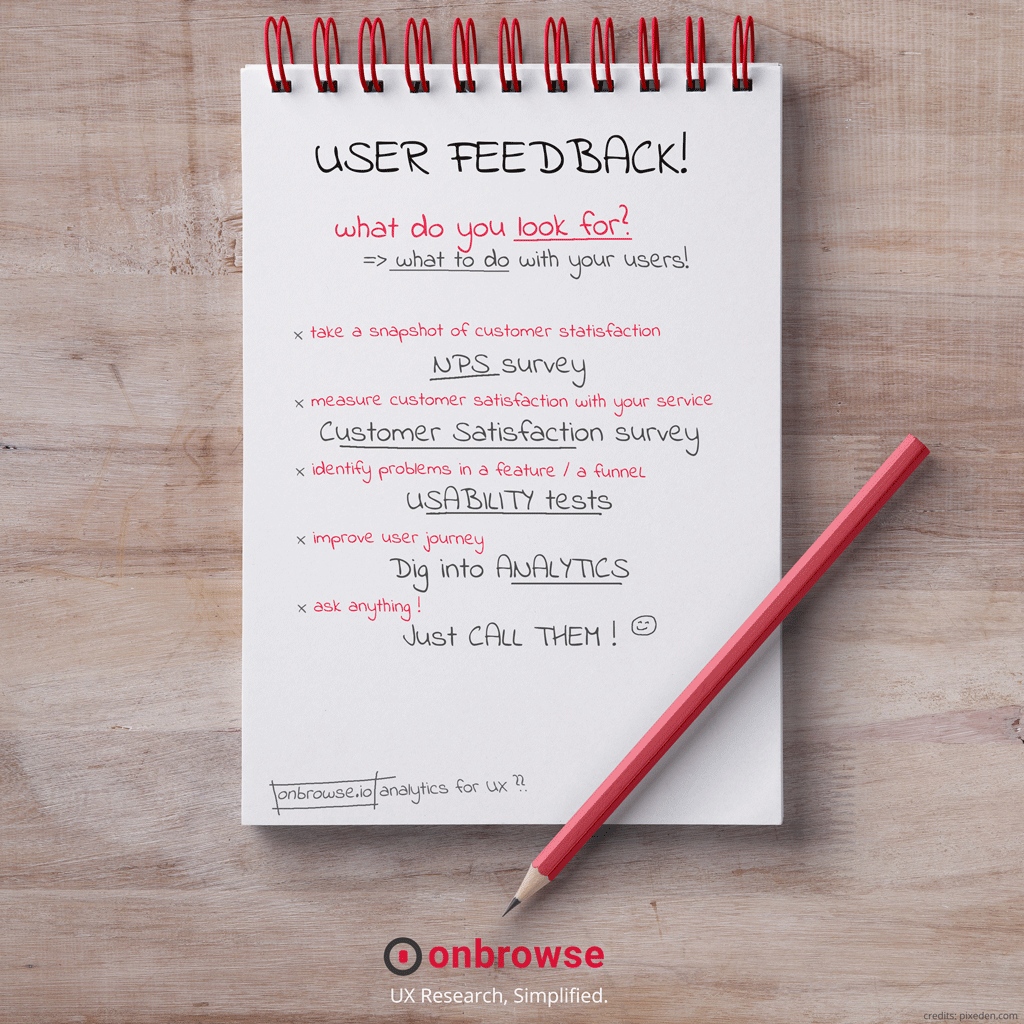
To get you started with qualitative feedback, here are five proven methods you can implement right away.
1. Conduct one-to-one user interviews
- What it measures: Everything you can ask :)
- Primary use: Ask anything you want to know
- How: Pick the phone or have a video conference with your users.
You might find this one obvious, but as entrepreneurs sometimes forget to talk with their users, and it’s a pity, we make it our first recommendation. It’s a great way to have direct feedback on what you’re building and how it’s perceived. It may help you solve some questioning you have with specific usage and find fresh ideas. In addition, you will develop your relationship with your users and build trust in your project.
2. Implement an NPS (Net Promoter Score) Survey
What it measures: How likely are your users to recommend your service
Primary use: Take a snapshot of customer satisfaction
How: NPS is a straightforward question you can ask your users through specialized services or any survey platform (google spreadsheet, Typeform, SurveyMonkey..)
The Net Promoter Score is the first indicator a product team should monitor.
First, the survey is relatively easy to run. Then, in addition, to give you an insight on the overall satisfaction with your service (you may ask every new user after one month of usage, or perform a yearly benchmark, for instance), it’s easy to store in your CRM to set different targets for your marketing actions.
It also has some limits: answers are binary* which implies you may collect negative feedback if you trigger it at the wrong moment (ex: when your user just went into a painful moment with your service), and you can’t poll the same user constantly. This is a reason why it requires a bunch of replies to get accurate.
3. Poll your customers with a satisfaction survey
What it measures: User satisfaction, needs, expectations ...
Primary use: Measure customer satisfaction with your product, your service, your company
How: Invite your users to complete an online survey through specialized services or any survey platform (Google Sheet, Typeform, SurveyMonkey ...)
A proper survey (which may include the Net Promoter Score, by the way) can help if you expect more than a snapshot of the satisfaction level of your users with your service. For instance, you may ask for their expectations, measure the relevancy of your decisions (after a specific process: signup, funnel, feature usage ...), measure the efficiency of your team (after a call to technical support ...).
Like the NPS survey, satisfaction surveys are limited because the data you get is declarative. It means you will get what, and only what, your users accept to share. Pay attention not to overload those surveys with too many questions. It may lower the number of replies, and you won’t find how to exploit all the results anyway. Get to the point with the questions you have today.
4. Perform qualitative user testings or usability tests
What they measure: How people (not necessarily your users) perceive and run through a specific part or process on your service.
Primary use: Identify potential problems or friction in a feature or a funnel
How: Implies to observe test subjects performing a specific scenario (example: complete a booking). This is done in various ways: on-site (moderated test) or on-demand (unmoderated user testing, performed by third-party service with anonymous testers, or through session recording services).
Jerry Cao’s guide "User Testing, explained" is a valuable read to evaluate which option could work the best according to your goal. You will have to choose between:
- Qualitative feedback with results in small quantity and highly specific. The moderated tests address your target persona, maybe even your users.
- Quantitative feedback with more results but with less quality. The testers may not fit within your target.
5. Collect User Behavioral Analytics
What they measure: How your users use your service.
Primary use: Identify how to improve the user journey
How: Use analytics to track data and visualize your users’ journey to deduce the pain points and find what may enhance their experience.
Analytics is often underestimated as "feedback" channels, but they are actually. What better feedback than to analyze in detail every user journey step by step, second by second?
Analytics tools are an extremely rich data source to visualize and understand what is going on with your service. They are powerful tools that can reveal what your users never tell you. Any scenario (funnel, feature use, etc.) can be analyzed in-depth and reveal potential problems. This analysis may even prove more accurate than user testings, thanks to a larger panel of data, which itself comes directly from your users.
But it also comes with disadvantages: it often needs proper configuration and analytics expertise to get the insights out of the data. Also, with some exceptions, analytics usually come with anonymous data. It doesn’t link the usage data -the sessions- and your customer base -who do what, and why?- which is the only limit to call it a feedback channel.
Analytics as a feedback channel: is it for today?
At Onvey, we built an in-house analytics platform, which delivers tools to visualize, measure, and understand User Experience delivered by our websites and SaaS platforms. You may very well use a solution like Google Analytics, Fathom, or Heap.
Analytics platforms allow product teams to collect induced feedback from visitors and users by crunching together context, usage, behavior, and engagement data from a single tracker. Thanks to dashboards, metrics, and scores, product owners know what performs great, moderately or not at all, in each feature and for every user journey. Data-driven insights allow us to identify what should be improved in the product and why, nurture roadmaps, and help define product priorities.
Why do we believe so much in data-driven feedback collection?
- Because it’s a proven method. Every activity taking part in web strategies gets more and more influenced and helped by data. Each time, data brings ROI through more customer engagement, more visibility on performance, more control on budget efficiency, and more flexibility by giving the hard work to the machine. It’s simple maths.
- Because it’s a rational method. Success comes from the ability to make significant product decisions. Counting on more data points gives better insights and lowers the risk of taking a wrong turn. To lead every product development strategy, faith & instinct are important, but logic is mandatory.
- Because users will be more and more at the center of every product move. No matter which iterative strategy product teams use, they will have to adapt to always being more reactive with their market and taking advantage of profuse, richer, and wiser feedback.
What about you? How do you collect feedback from your users? We would be more than happy to read your reactions.
Conclusion
There is more than one way to collect qualitative feedback.



